Technology
Inside Sema: The Architecture Behind a Trustworthy Answer
Sema Team · July 28, 2026 · 3 min read
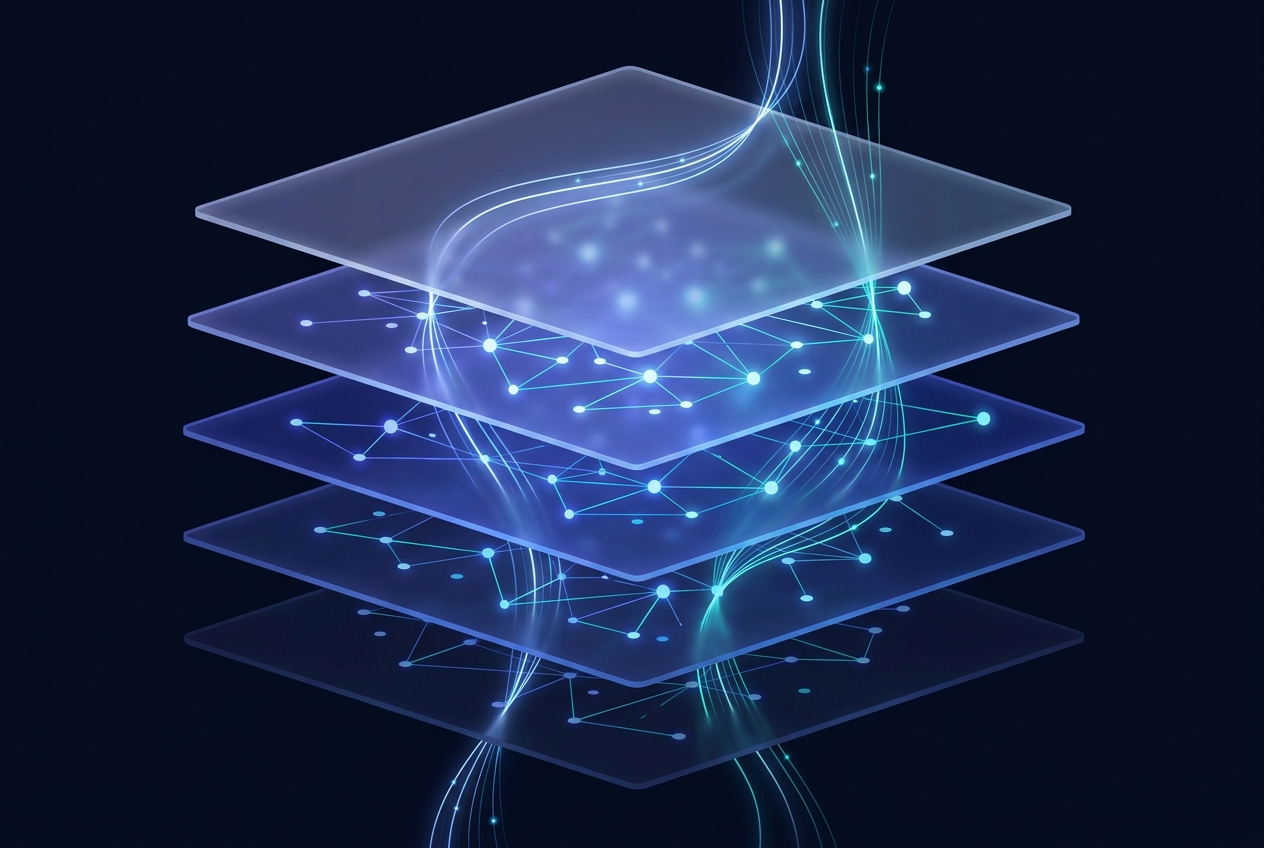
It takes an afternoon to wire an LLM to a database. It takes a lot longer to make the answers trustworthy. The distance between those two things is Sema's architecture — six layers that each solve a hard problem, working as one pipeline from a plain-English question to a governed, signed answer.
The pipeline, end to end
Question → Semantic graph → Governed planner → Sandboxed SQL → Auto-viz → Signed evidence
Let's walk each layer and why it's hard.
1. Semantic knowledge graph
Not a wiki of definitions — a typed control plane. Entities (customer, order, facility), their attributes, verified joins with keys and cardinality, and first-class metrics with real formulas. Sema bootstraps this by introspecting your schema and profiling data, then drafts plain-English definitions for you to confirm. Confirm a join once and every future answer inherits it.
Why it's hard: inference has to be good enough to be useful and conservative enough to never assert a wrong relationship. This is also the reason Sema doesn't hallucinate on your data — the model plans against the graph, not raw tables.
2. Grounded planning + repair
The LLM's job isn't to "write SQL from a string." It's to plan against approved entities and metrics from the graph. Generation is constrained to what exists; the planner resolves the question to specific nodes, and if execution errors, a single safe repair-retry attempts a fix without ever relaxing scope or policy.
3. Policy & RBAC engine
Before a single row is read, the plan passes through governance: the requesting user's role resolves their entitlements, restricted columns are masked or refused, and row policies scope the result. Enforcing this at plan time — not after results return — is what keeps restricted data out of both the model's context and the user's screen. (More in governance that scales.)
4. Sandboxed execution
Approved SQL runs in an ephemeral, network-isolated runner, read-only, after static analysis. No shared privileged connection, no write path, no way for a generated statement to reach beyond its sandbox.
5. Auto-visualization
The result's shape decides the chart: a time series becomes a line, a breakdown becomes bars, a single figure becomes a stat, geographic data becomes a map. This is the difference between a chatbot that prints a table and a system that hands you the right view automatically.
6. Cryptographic evidence + audit
Finally, the question, SQL, lineage, and access context are bundled and signed with an Ed25519 key, and the whole interaction lands in an append-only audit log. The signature is the trust anchor — tampering is detectable, and the pack can be shared as an expiring read-only link.
Why the whole is greater than the parts
| Layer | The hard problem it owns |
|---|---|
| Semantic graph | Encoding meaning + verified relationships |
| Grounded planner | Correct SQL, not plausible SQL |
| Policy engine | Enforcement before execution |
| Sandbox | Safe, isolated running |
| Auto-viz | The right chart for the answer |
| Evidence + audit | Provable, tamper-evident answers |
Any one layer is months of specialised engineering. Stacked together, they're the reason an answer from Sema is something you can put in front of an auditor — and the reason "just add an LLM to your database" never gets you there. If you want the product-level view of what this unlocks, read beyond chat-with-your-data.
Frequently asked questions
Why not just send the question straight to an LLM with the schema?
Because the model will guess at meaning, invent joins, and occasionally fabricate columns. Grounding it in a typed semantic graph constrains generation to approved entities and metrics, which is what turns a plausible-looking query into a correct one.
Where does the SQL actually run?
In ephemeral, network-isolated sandboxes, read-only, after the generated SQL is statically analysed. If it errors, Sema attempts one safe repair before giving up — it never loosens governance to force a result.
What exactly gets signed?
A bundle containing the question, the executed SQL, the lineage (tables and joins), and the access context, signed with an Ed25519 key. Re-verifying the signature detects any change to the bundle.
See a governed semantic layer on your own data
Connect a source or upload a CSV, and ask your first plain-English question in minutes — every answer ships with its SQL.