

Pillar guide
The Semantic Layer: The Complete Guide for Data Teams (2026)
Sema Team · June 8, 2026 · 5 min read
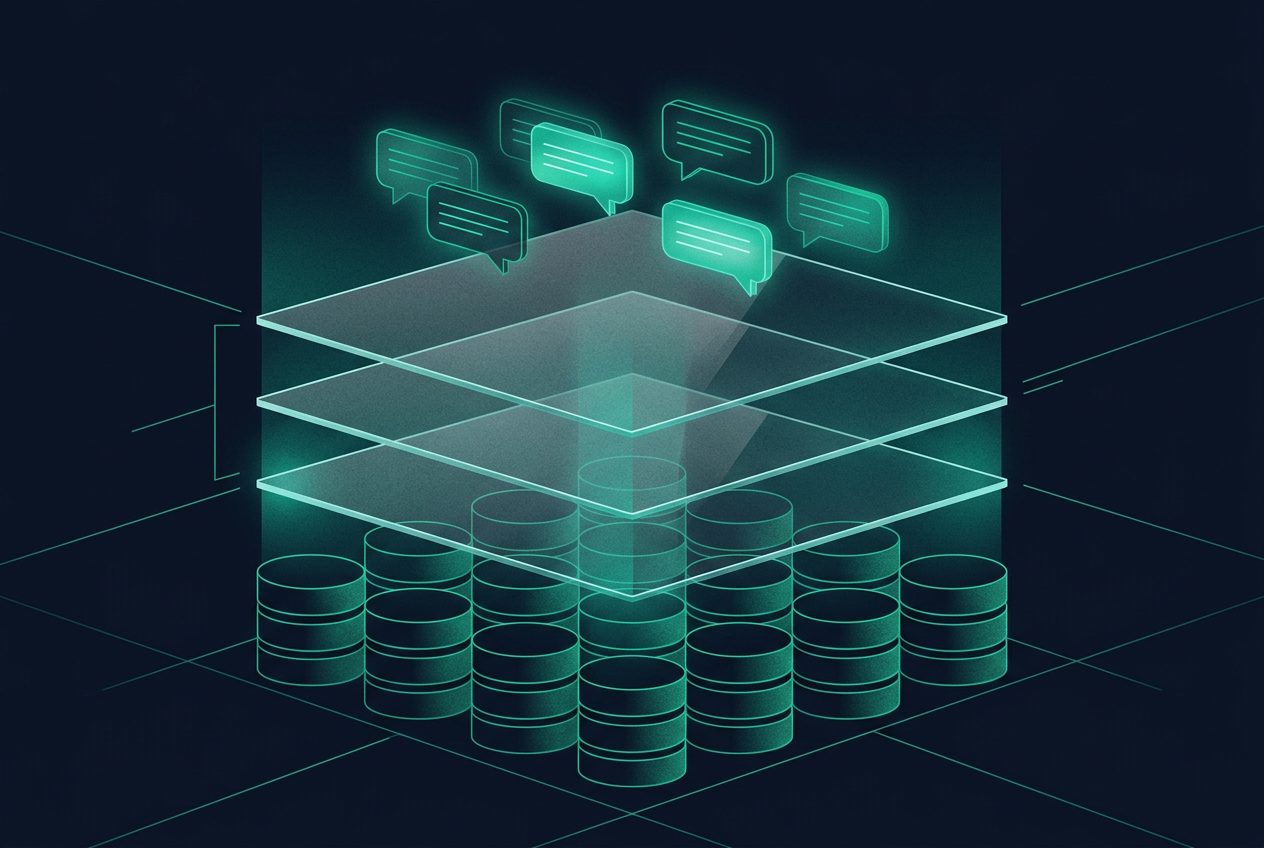
Every data team eventually hits the same wall: the warehouse is full, the dashboards are plentiful, and nobody agrees on what "active customer" means. Then someone points an LLM at the database and the wall becomes a cliff — now wrong answers come back in fluent, confident English.
The fix for both problems is the same piece of infrastructure: a semantic layer. This guide covers what it is, why AI made it urgent, how the architecture works, and how to choose and roll out a semantic layer in 2026.
What is a semantic layer?
A semantic layer is a translation layer that sits between your raw data (warehouses, databases, lakehouses) and everything that consumes it (BI tools, AI assistants, reports, APIs). It encodes the meaning of your data:
- Entities — what a "customer", "order" or "visit" actually is, and which tables represent it
- Relationships — how tables join, and which join paths are valid
- Metrics — precise definitions like "churn = customers whose subscription lapsed in the period, excluding trials"
- Terminology — the business glossary that maps company language to schema
- Policy — who can see what, which columns are sensitive, and what must be masked
If that sounds like documentation, here's the difference: a semantic layer is executable. When someone asks "what was enterprise churn last quarter?", the layer resolves the terms, picks the right tables and joins, applies the metric definition, enforces access policy, and produces correct SQL. Documentation describes; a semantic layer decides.
For a shorter primer, read What is a semantic layer? — this guide goes deeper.
Why the semantic layer became essential in the AI era
For fifteen years the semantic layer was a nice-to-have that lived inside BI tools (BusinessObjects universes, LookML models). Three things changed:
1. LLMs write SQL now. Text-to-SQL is genuinely good at syntax and genuinely bad at semantics. An LLM will happily join users to orders on the wrong key, count test accounts as customers, and sum a column that was deprecated two years ago. It doesn't know your business — and that's why LLMs hallucinate on analytics questions. The semantic layer is the grounding that makes AI answers trustworthy.
2. Consumption fragmented. Metrics used to live in one BI tool. Now they're consumed by chat interfaces, notebooks, reverse ETL, embedded analytics and agents. Definitions embedded in a single tool can't serve all of them; a universal semantic layer — independent of any one consumer — can.
3. Governance got teeth. GDPR, HIPAA, SOC 2 and internal privacy programs mean "who saw which column, and why" is now an auditable question. When queries are machine-generated, policy must be enforced at query time, not by convention. That's text-to-SQL governance, and it only works with a semantic layer in the path.
The architecture of a modern semantic layer
A production semantic layer in 2026 has five components:
1. Connection & discovery
The layer connects to sources (Postgres, Snowflake, BigQuery, Databricks, files) and profiles them: tables, columns, types, cardinality, sample values. Modern tools infer relationships automatically with evidence — foreign keys, naming conventions, value overlap — instead of requiring hand-drawn ER diagrams.
2. The knowledge model
Discovery output becomes a reviewable model: entities, relationships, and a business glossary of terms mapped to schema. Crucially, this model is versioned and owned — data teams approve or correct what discovery proposed, and the model improves with feedback.
3. Metric definitions
Metrics are defined once — including grain, filters, and edge cases — and reused everywhere. "Revenue" means the same thing in a chat answer, a scheduled report, and an alert threshold. This is the metrics-layer subset of the semantic layer; see semantic layer vs metrics layer vs data catalog for how these categories relate.
4. Query generation & execution
When a question arrives — from a human in plain English or a BI tool via API — the layer resolves it against the model and generates SQL. The critical property is explainability: every answer should ship with the SQL that ran, the tables it touched, and the definitions it used. If you can't audit the answer, you can't trust it.
5. Governance & policy enforcement
Role-based access control, restricted-column masking (see PII and masking for AI analytics), and an append-only audit log. Policy lives in the layer, so every consumer inherits it automatically — including the AI.
Build vs buy: evaluating semantic layer tools
The market splits into three camps:
| Approach | Examples | Strengths | Watch out for |
|---|---|---|---|
| BI-embedded | Looker (LookML), Power BI datasets | Mature, tight BI integration | Definitions locked into one vendor's tool |
| Headless metrics | dbt Semantic Layer, Cube | Code-first, API-driven, composable | Modeling effort up front; governance often out of scope |
| AI-native semantic layer | Sema | Automatic discovery, plain-English querying, query-time governance | Newer category; evaluate explainability carefully |
We've written honest, detailed comparisons: Sema vs dbt Semantic Layer, Sema vs Cube, Sema vs AtScale, and Sema vs Looker.
Questions to ask any vendor:
- Time to first trusted answer — hours, days or months?
- Explainability — can a non-engineer see the SQL and lineage behind every answer?
- Governance depth — is masking enforced at query time, or is it a wiki page?
- Consumer coverage — chat, BI, API, reports, alerts — or just one?
- Feedback loops — when a definition is wrong, how fast does the fix propagate?
Rolling out a semantic layer: a 30-day plan
Week 1 — Connect and discover. Point the layer at one high-value source. Review inferred relationships and the draft glossary. Don't aim for completeness; aim for the 20 tables that answer 80% of questions.
Week 2 — Define the metrics that cause arguments. Every company has five metrics with contested definitions. Write them down, get sign-off from finance/ops, encode them. This is where the political work happens — the tool just makes the decision durable.
Week 3 — Turn on governed access. Classify sensitive columns (good tools auto-flag PII), set role policies, enable the audit log. Then open access to a pilot group outside the data team.
Week 4 — Measure and expand. Track questions asked, answers accepted, and definitions corrected. Self-service analytics fails when trust breaks — the metric that matters is whether people act on answers without double-checking them in a spreadsheet.
The bottom line
The semantic layer stopped being optional the day your team started asking an AI questions about your data. The only real choice left is whether meaning and policy live in a governed, shared layer — or scattered across dashboards, tribal knowledge and prompt templates.
If you want to see a discovery-first semantic layer on your own schema, Sema connects in minutes and every answer ships with its SQL.
Frequently asked questions
Do I need a semantic layer if I already use dbt?
dbt transforms data and can define metrics, but a semantic layer also covers business definitions, access policy, and query-time governance for consumers like AI chat, BI and APIs. Many teams run dbt for transformation and a semantic layer on top for consumption. See our detailed comparison of Sema vs the dbt Semantic Layer.
How long does it take to implement a semantic layer?
Traditional modeling-first tools take months because every entity, join and metric is hand-written. Discovery-first tools like Sema profile your schema, infer relationships and draft a glossary automatically, so a usable layer exists in days and is refined continuously.
Is a semantic layer only useful for AI and LLMs?
No — BI consistency, self-serve analytics and metric standardization were the original drivers. But LLM-based analytics made it non-negotiable: without a semantic layer, text-to-SQL systems guess at meaning and get it wrong confidently.
What's the difference between a semantic layer and a metrics layer?
A metrics layer is a subset: centralized metric definitions. A semantic layer also includes entities, relationships, business terminology, and — in modern implementations — governance policy that is enforced at query time.
See a governed semantic layer on your own data
Connect a source or upload a CSV, and ask your first plain-English question in minutes — every answer ships with its SQL.
Keep reading
Semantic layer
What Is a Semantic Layer? A Practical Definition for Data Teams
Governance
Text-to-SQL Governance: How to Let AI Query Production Data Safely
Semantic layer
Semantic Layer vs Metrics Layer vs Data Catalog: What's the Difference?
Comparison
Sema vs dbt Semantic Layer: Which Semantic Layer Do You Need?